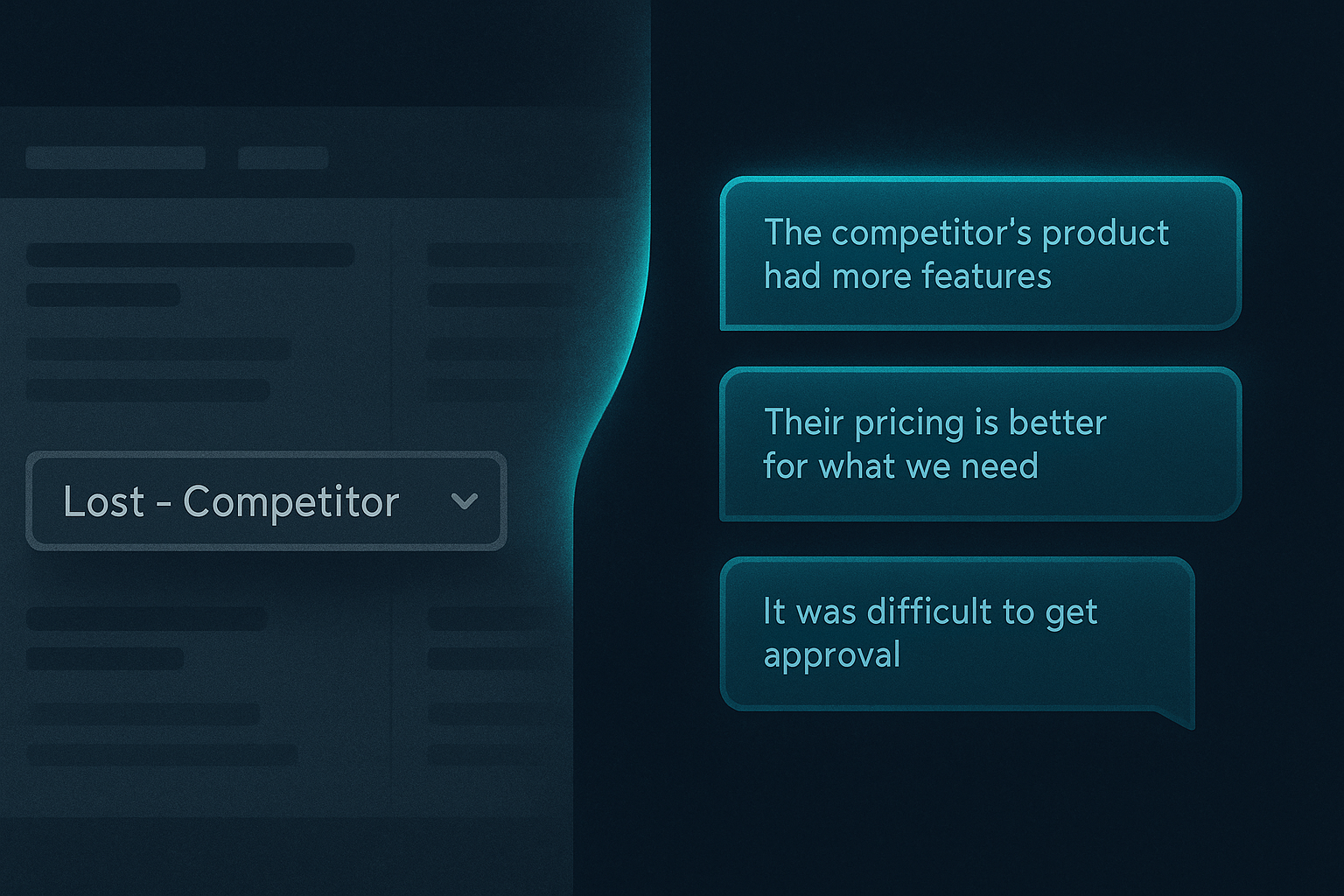
Every sales leader has seen it. The deal closes as a loss, the rep logs “went with a competitor,” and that’s the end of the story. Maybe there’s a dropdown selected — price, features, timing — and then the CRM moves on.
But here’s what I’ve learned after watching hundreds of go-to-market teams try to build competitive intelligence programs: the story the buyer tells internally about why they chose your competitor is almost never the same story that ends up in your CRM. And the gap between those two stories is exactly where your competitive strategy is either built or buried.
Why Your CRM Loss Reasons Are Lying to You
Let’s be direct about what a CRM loss reason actually is: it’s a rep’s best guess, entered under emotional duress, into a single dropdown field, often days after the decision. It is not competitive intelligence. It is a filing mechanism.
Research from Primary Intelligence — which has conducted over 50,000 win/loss interviews — found that sales reps attribute losses to price 48% of the time. Buyers cite price as the primary factor only 23% of the time. That’s not a rounding error. That’s a systematic misread of why you’re losing.
Why does this happen? A few reasons:
- Reps protect their ego. “We lost on price” is a far easier thing to write than “I never built enough credibility with the economic buyer” or “our champion couldn’t sell it internally.”
- Buyers are diplomatic. When your rep asks the buyer what went wrong, the buyer gives a polite, non-threatening answer. They’re not going to tell someone they’re never going to work with again that the sales process made them feel uncertain about the vendor’s stability.
- CRM fields aren’t built for nuance. You can’t capture “the competitor’s CSM showed up to the final call and it changed the energy in the room” in a picklist.
The result is a dataset that systematically undercounts trust issues, champion failures, and competitive positioning gaps — and overcounts price as the culprit. If you’re making strategic decisions based on CRM loss reasons, you’re making them on corrupted data.
What “We Went With a Competitor” Usually Masks
When a buyer tells your rep they went with a competitor, that sentence is doing a lot of work. It’s covering for at least one of five dynamics that rarely make it to the surface:
1. Price framing, not price. In most competitive losses that get logged as “pricing,” the issue isn’t that your number was too high — it’s that your value story never landed, so price filled the vacuum. The competitor didn’t necessarily win on cost. They won because their narrative made the cost feel like a no-brainer. That’s a positioning problem, not a pricing problem.
2. Trust gaps. This one is hard for reps to log honestly, but it’s endemic. Trust gaps show up as: slow response times that made the buyer wonder about post-sale support, inconsistencies between what marketing promised and what sales delivered, or a demo that felt generic rather than tailored. The buyer chose the competitor because they felt safer going that direction — and that feeling was earned or lost in specific moments throughout the cycle.
3. Champion failure. Your champion believed in you. They just couldn’t sell it internally. Maybe they didn’t have the budget authority they implied they had. Maybe the CFO brought in a preferred vendor at the eleventh hour. Maybe your champion got outvoted in the final decision meeting. None of this is visible from the outside — and none of it will show up in your CRM — but it’s one of the most common reasons competitive deals are lost.
4. Timing and sequencing. The competitor was already in conversation before you were. Or they pushed for a timeline that worked in their favor. Or your deal got delayed and the buyer’s budget window closed. Competitive losses that look like “they had better features” are often actually about who structured the buying process in their favor.
5. Feature gaps — but not the ones you think. Reps know about the feature gaps they’ve been asked about in demos. What they don’t know is which features the buying committee debated after the demos were done, and which ones tipped the scales. Post-sale buyer intelligence consistently surfaces feature concerns that never came up once during the active deal cycle.
Why Debrief Calls Don’t Get You There
The standard playbook is to have someone — the rep, a sales manager, maybe a product marketer — call the buyer after the loss and ask what went wrong.
I’ve done this. I’ve been on the receiving end of these calls. Here’s what happens: the buyer gives you something. It’s usually true enough to sound useful, vague enough to be non-threatening, and nowhere near the real story.
Buyers are not going to tell a vendor’s employee that their champion was ineffective. They’re not going to say “we never trusted your pricing model” to someone who still works at the company. They’ll say something like “the other tool had a few features we needed” and leave it at that. You hang up thinking you learned something. You didn’t.
Candid feedback requires psychological distance. That’s why third-party win/loss interviews — conducted by someone who isn’t invested in the outcome — have always outperformed internal debriefs. The buyer is more likely to say what actually happened when the person asking has no stake in the answer.
How to Actually Surface the Real Competitive Story
The gold standard for competitive loss analysis is a structured interview with the buyer, conducted by a neutral third party, within a short window after the deal closes. The sooner, the better — decision rationale fades fast.
Traditionally, this meant hiring a research firm, scheduling interviews weeks out, waiting months for synthesized reports, and spending $20,000+ on a program that covered a fraction of your closed deals. Most teams couldn’t justify it at scale.
That’s the gap Know Why was built to close.
When a deal closes in your CRM, Know Why automatically sends your buyer a personalized invitation to share candid feedback through an AI-conducted interview. No scheduling. No interviewer bias. No waiting weeks for a report. The AI asks the right questions — probing on decision criteria, competitor comparisons, trust factors, champion dynamics — and delivers structured competitive intelligence to your team within hours.
Because the interviewer is AI rather than a human tied to your company, buyers speak more candidly. Because it’s automated, you get coverage on every closed deal — not just the ones someone remembered to follow up on. And because it connects directly to your CRM, the intelligence flows back into the context where your team actually works.
What to Do With the Real Competitive Narrative
Getting honest competitive intelligence is only valuable if you act on it. Here’s where the insights actually land:
Update your battle cards with real buyer language. If buyers consistently say a competitor “felt like a safer bet” because of their customer success model, that’s an objection you need to address proactively — not discover three months from now. Your battle cards should reflect what buyers actually say, not what your reps assume.
Feed trust signals back into the sales playbook. If competitive losses cluster around specific moments in the cycle — a slow response window, a generic discovery call, a demo that didn’t map to their use case — those are coaching moments. Not performance reviews. Coaching moments.
Take champion failure seriously as a product. If your buyers’ internal champions are consistently failing to get deals over the finish line, that’s a sales enablement problem. You need better leave-behind materials, clearer ROI frameworks, and executive engagement strategies that don’t depend on a single internal advocate.
Give product real buyer quotes, not internal assumptions. When the real feature gap surfaced wasn’t the one in your CRM, that matters. Product roadmap prioritization based on actual buyer language — “we went with them because they had [X]” — hits differently than a VP guessing what buyers care about.
The Competitive Intelligence You’re Leaving on the Table
Every closed-lost deal is a primary source. Someone who just evaluated your category, ran a full competitive assessment, and made a final decision is sitting on intelligence that your product team, your sales team, and your marketing team would pay for. And in most companies, that intelligence disappears the moment the rep logs the loss.
The rep moves on. The buyer moves on. And the real story — the one about why they chose your competitor — never gets captured.
You can keep making decisions based on sanitized CRM data and polite debrief calls. Or you can build a system that gets you the actual story, automatically, on every deal.
One of those paths leads to a competitive strategy built on evidence. The other one just recycles the same assumptions quarter after quarter.